
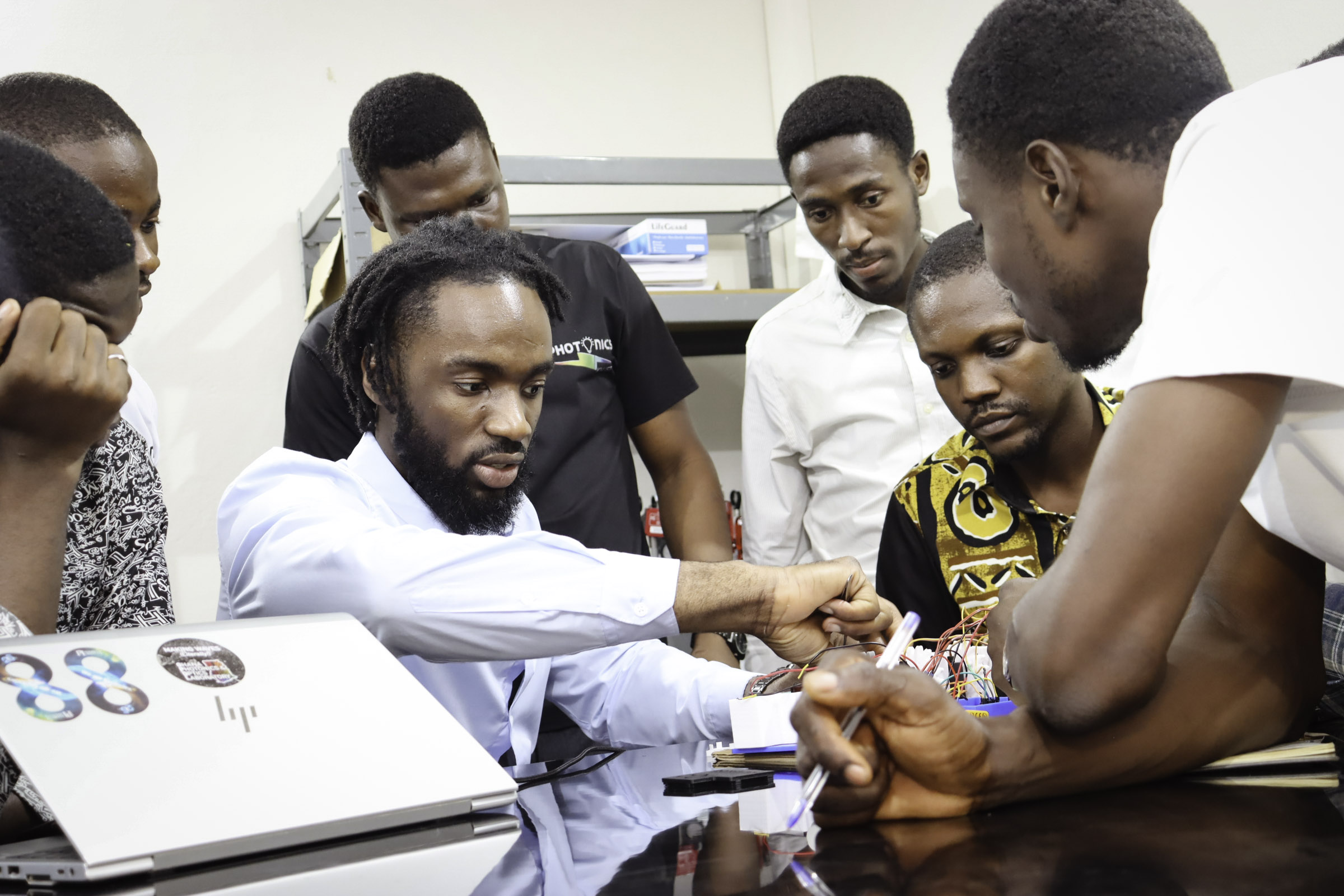
The Ghana Photonics and Optics Laboratory (GPOL) at the Kwame Nkrumah University of Science and Technology (KNUST) has held a hands-on workshop to help students and researchers understand how quantum technology can be used to protect digital messages from hacking.
The workshop focused on Quantum Key Distribution (QKD), a method that uses the laws of quantum physics to securely encrypt information such as emails, banking data and private messages.
The training was organised as part of activities marking the International Year of Quantum Science and Technology, declared in 2025 to raise public awareness of the growing importance of quantum science and its applications.
Mr. Silas Ifeanyi, an Engineering Education Developer with the Pearl Sullivan Engineering IDEAs Clinic at the University of Waterloo, demonstrated how a quantum key distribution kit works.
“The system is used to transmit a key, with each light that passes through encoding photons, which means associating a value,” he explained.
He said quantum key distribution enables secure communication by using the principles of quantum mechanics to encrypt and decrypt information, making it more advanced than conventional methods.
“Quantum key distribution uses single-photon signals to establish a secure secret key. This makes it possible to detect if there is an eavesdropper tapping into your message,” he said.
Mr. Ifeanyi explained that the QKD system used during the workshop was developed through a collaboration between the IDEAs Clinic and the Institute for Quantum Computing, and was designed specifically for hands-on learning.
“It was designed to allow students to practically engage with quantum key distribution as a method of cryptography that utilises quantum technology,” he noted.
He described quantum key distribution as essential for the future of secure communication.
“QKD is very important if you care about secure communication in any form. It ensures that information being sent from one party to another remains protected,” he said.
Mr. Ifeanyi also warned that many existing security systems are becoming increasingly vulnerable as computing power advances.
“Our current methods of cryptography are vulnerable, and with the advent of quantum computers, we will need a more secure way to send messages whether it’s banking information or simple text messages,” he said.
The workshop ended with practical sessions in which students assembled the quantum communication system themselves and applied their learning to real-world quantum cryptography exercises.


